Developmental Assessment + Parent Support
Focused assessment includes a parent interview, play-based observation with your child, personalized support and practical recommendations for home + school

Neurodiversity-affirming assessment and recommendations
Let’s connect your child’s unique patterns of emotional regulation with sturdy brain-body-behavior support.
Many families drawn to my work are looking for clarity about what type of support will be the best fit. While I’m certainly prepared to follow your instincts about your child’s needs—part of my job is helping you identify which interventions are likely to be most effective and connect with right-fit supports.
Over many years of practice and training, I’ve developed a unique approach to play-based assessment that takes into account your family dynamics, your child’s current strengths and areas of challenge, and the bigger picture of their social, emotional, and developmental skills, as well as where they could benefit from additional resources or a shift in expectations.
This process helps you become an expert in your child’s patterns and behavior, so you can lean into curiosity about what needs are fueling them, decode their non-verbal cues before things go sideways, and help set them up for success and connection across home, school, peer relationships, camps, sports, and beyond!
Because there’s more than one way to navigate social skills and academic learning—together, we’re embarking on a process of making new connections and predicting sticky spots—so you, and they, can feel more prepared and empowered to meet their needs as they grow.
As part of the initial parent interview, we’ll decide together which assessment tools match your needs, including developmental questions and therapy goals.
Finally get the right kind of support.
Short-term, play-based assessment with tailored guidance for next steps and practical tips for educational advocacy.

Looking under the surface of behavior
means getting curious about what needs our attention
What to expect:
First, we’ll meet for an initial parent video consultation, without your child, to get a sense of your goals and concerns, as well as your child’s strengths. We’ll plan next steps together.
Our activity-based, strengths-focused process prioritizes your child’s pace and perspective, getting curious together about what makes their brain happiest—from their preferred types of play and sensory engagement to social communication strategies, even if your child is non-verbal. The assessment process is neurodiversity-affirming with practical skills focus, with attention to what specific supports and structure are likely to be most accessible for your child’s current developmental stage and beneficial for their continued growth.
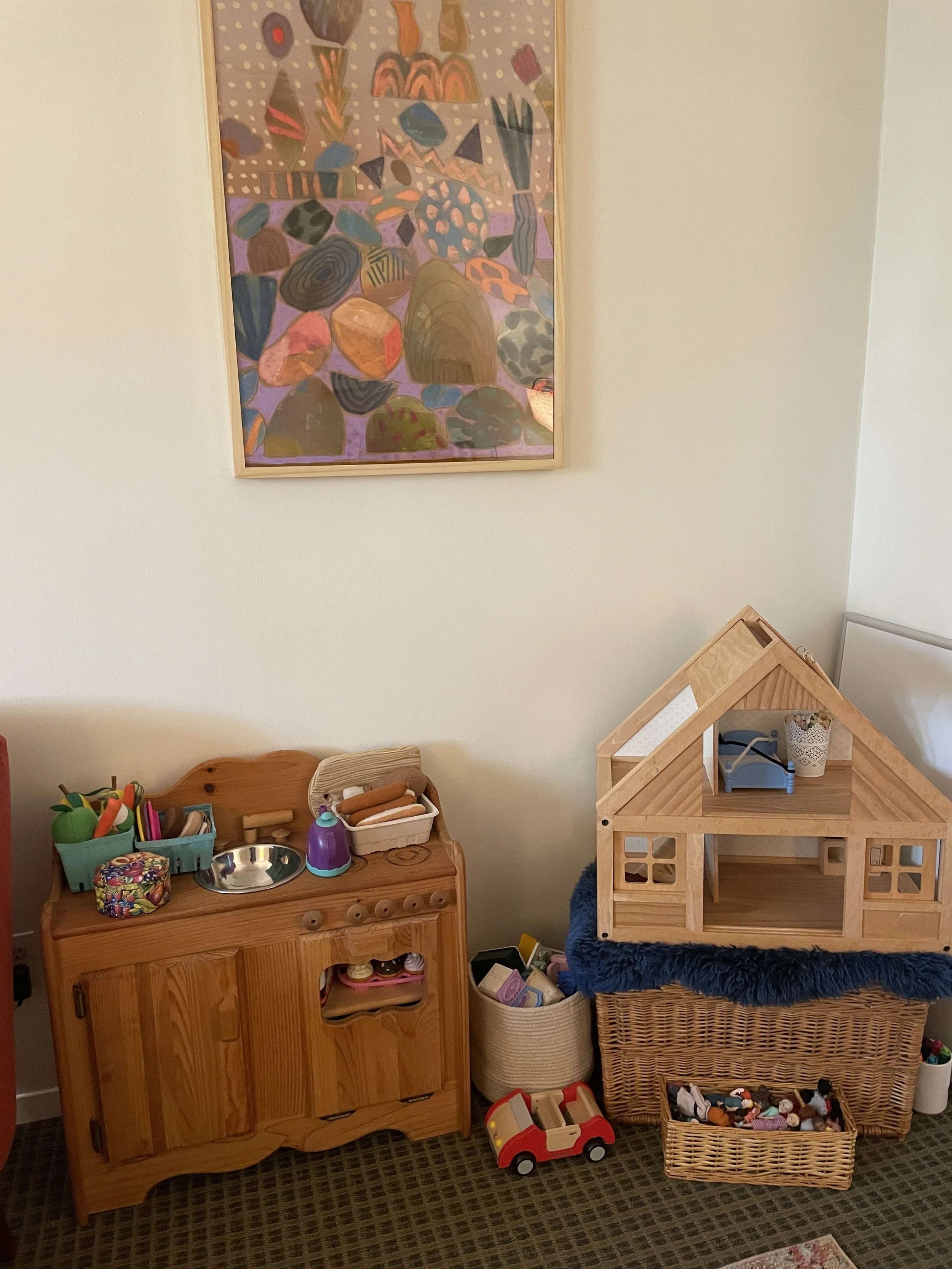
Over a series of 2-5 sessions, your family will get dedicated access to the playroom, tailored resources, and priority scheduling for our post-assessment feedback session. This whole family approach is the foundation of collaborative care and effective advocacy.
Coming from out of town? Or have a need for more immediate feedback? The 2-Day Deep Dive model allows us to tailor care for your child and family in a burst of focused exploration over 1 or 2 half-days of concentrated time in the playroom. We’ll collect all your questions and observations together, so we can engage the “detective work” of behavioral and developmental inquiry at the same time we’re strategizing support. This intensive format can include screening for autism and ADHD traits, considering sensory differences, coordinating care for children with complex needs, collaborating with schools, and providing resources that fit your specific child’s strengths and needs—as well as your capacity.
Assessment Areas for Consideration

Autism + Autistic Traits
During a play session with structured activities and play scenarios, we’re considering verbal and non-verbal communication, social skills, imaginative play, focused interests, and sensory preferences.
Standardized measures include parent interview, developmental history, caregiver questionnaires. 45-60 minute play session

ADHD and Anxiety
Gathering input from multiple perspectives helps us draw a dynamic picture of your child’s behaviors at home and school, including developmental history and understanding how they see themselves. We’ll get curious about their current social strategies, behavior, attention and focus, sensory differences, and emotional regulation.
Play-based observation (50-60 minutes) and caregiver questionnaires.

Sensory Differences
Using flexible sensory-based tools offers a strengths-based, descriptive approach that honors each child’s unique “brain style” with special attention to reflecting coping skills, needs and sensitivities often missed by traditional academic testing, including complex presentations, 2e/gifted kids, girls & non-binary youth.
30-45 minute play session, parent interview, developmental history
some questions we can answer together…
-
Self-regulation is a complex set of skills. Together we’ll look at how sensory processing, reading social cues, verbal and non-verbal communication, and other factors might influence their access to cognitive problem solving under stress. Common regulation tools might include physical, sensory, and communication strategies, as well as building new skills.
-
Maybe! When we think about what might be getting in the way of cooperation, flexibility, focus, and the ability to put the breaks on or shift gears…there’s a lot of moving parts. If you’re already seeing that being clear and consistent about expectations isn’t doing the trick, we’ll get curious about what else is causing static. And I’ll help you with a few new tools.
-
Lots is often different between home and school. Some key variables are structure, predictability, and level of challenge. Some of the factors we can’t always “see” include sensory input, social dynamics, role changes and expectations, cognitive load, group transitions, emotional regulation, situational or separation anxiety, learning differences, and right-sized power. Let’s get curious together!
-
Maybe. We’ll look at behavioral and school-related patterns, including where they experience stress or challenge, how manageable it feels, and whether teaching executive function or emotional regulation skills is something they’re ready and available for. I’m always happy to share specialty referrals.
-
Sensory processing is the neurological process of the brain and body working together to receive, organize, and respond to data collected through the senses—both inside the body and from the environments we’re in. It’s a foundational and mostly invisible process that informs our regulation baseline. So, yes, it’s part of how we navigate the world and can absolutely influence how we perceive what’s happening inside, outside, and in between us and other people. Sensory differences often—but not always—accompany other developmental differences and might be supported with everyday routines, specific treatments, or need no intervention at all. I’m happy to share specialty referrals, as needed.
-
Twice-exceptional (or 2e) individuals are often recognized as being both intellectually gifted and simultaneously shaped by other neurodivergent trait/s. In fact, giftedness is regarded as a neurodivergence (in comparison to a more commonly occurring IQ range), and often shows up in tandem with traits of deep curiosity or special interests, the capacity to hyperfocus, asynchronous development in other areas (emotional regulation, for example), or coexisting differences in sensory processing, motor skills, social interaction, communication patterns, ADHD traits, or anxiety. These clusters of difference are not inherently a problem; it’s often when social context and expectations don’t fit a child’s specific strengths or comfort zone that they can experience additional stress.
This is the social model of disability—recognizing social expectations as a salient stressor, rather than framing as a deficit the way a given child operates. We can have significant influence when we understand more about an individual child’s needs and strengths—like their brilliance!—and what other factors we can build on to support their overall growth.
Highlights
You’ll join your child to observe play-based assessments.
Parent feedback session includes discussing report, answering your questions, support for making meaning of the results, and identifying next steps.
Family support session includes sharing assessment results with your child to support future conversations at home.
Assessment questionnaires may be collected from you and 1-2 adults who know your child well. You’ll determine whether a teacher, relative, or family friend might be helpful.
You’ll get a comprehensive written report summarizing your child’s developmental history, assessment results, diagnostic impressions, and personalized recommendations. This may be used to request school-based accommodation or specialized supports.
Assessment Steps

Parent Intake - virtual

Developmental History - virtual

Play-Based Assessment (60-90 min)
— We may need more than one —

Parent Feedback - virtual


Family Support - share results
Deep Dive Assessment (2 day intensive)
why book in-depth assessment over one or two days?
By request, I’ve designed a short-term, focused approach to play-based assessment for the whole family. As an alternative to a typical 4-6 session series, you can reserve 1-2 days of dedicated support for your whole family—this is the Deep Dive Assessment option*—including both parent and child support. This is a great option for families traveling from out of town or busy households with shifting schedules. In either case, recurring appointments can be tricky, so we plan a Friday/Saturday combo to get it done.
You can expect:
Immediately useful reflections on emotional maturity, developmental surges and lags (a mixed profile is common), current stress coping strategies, and executive function strengths
Insights about what needs may be fueling behavior challenges, as well as strategies most likely to be effective
In-depth feedback across important developmental areas of self-regulation, sensory integration, relationship skills, and cognitive problem-solving
Focused parent coaching and portable, flexible tools for regulation and positive communication
Understand your own communication and stress-coping patterns as a starting point for positive shifts toward regulating the whole family
Respectful, neurodiversity-affirming approach to helping your child learn about their own brain and strengths to build on—with conversation starters to keep the discussion going at home & school, as needed
we’ll work together to build a menu of services and gentle schedule, including just what you need.
Play-Based Assessment, with the nervous system and ages/stages of development in mind
Standardized measures to screen for Anxiety, ADHD and/or Autistic traits, by request we can combine these to address your specific questions
Personalized Parent Coaching, in conversation with me, or together with your child engaged in play activities—so you can practice in real time
Adult Attachment Interview to help you understand how the ways you were parented may be influencing your parenting—including what you appreciate about that and what you might want to do differently in raising your particular child
Recommended next steps, including specialty referrals for any follow-up evaluations, therapy, or academic supports we identify together
location
We’ll meet at my office / playroom in NE Portland’s Hollywood District. On-site parking, covered bike racks, and public transit accessible. The building has an elevator and private, all gender restrooms. I’m happy to share some of my favorite nearby food spots, if we’re spending a whole day together!
investment
Assessment is billed at $200/hour, with a Good Faith Estimate of both time and fees provided at the start of services. Partial reimbursement may be available, depending on your coverage and Out Of Network benefits, for standard assessment and therapy sessions with me (45-60 minutes, including a documented diagnosis); I encourage families to check these benefits before we start. *Please note: Insurance coverage is typically not available for deep dive/intensive services.
Meet MereAnn
MereAnn Reid, LPC, RPT, is a licensed professional counselor and clinical supervisor, registered play therapist, and certified AutPlay provider with focused training in developmental assessment.
As a therapist in private practice for 17 years, I’ve built a specialty in neurodiversity-affirming assessment and parent support as I’ve come to understand essential overlaps between sensory processing, nervous system regulation, chronic stress, and my own regulation and sensory needs in a highly relational career.
I’m a clinical supervisor supporting fellow play therapists, a Level-II trainer with the Neurosequential Network—a brain-based, developmentally-sound, attachment-focused approach to assessment, Certified AutPlay provider, Level-III certified clinician in Understanding PDA, and trained in autism and ADHD assessment with school-age kids. My practice is informed by the empowerment and capacity that comes from blending brain science, sensory-smart play and family systems thinking to support different ways of learning and communication.